

Retail execution is never about doing more, but it has been about doing the right tasks at the right time. Checklists brought discipline to store ops, but as the retail network is growing, companies need a tool that is more proactive.
Recent discussion in the retail industry points to a future where every store “has a brain”, a system that constantly ingests and interprets information, turning intelligence into action.
This shift is giving rise to a new operating model: the Ops Brain. Built on existing checklists, it elevates store execution by helping modern retailers move from structured activity to real-time retail intelligence.
Retail Intelligence Needs an Ops Brain
An Ops Brain represents the next stage of retail intelligence. One that is embedded directly into daily execution rather than reviewed after the fact.
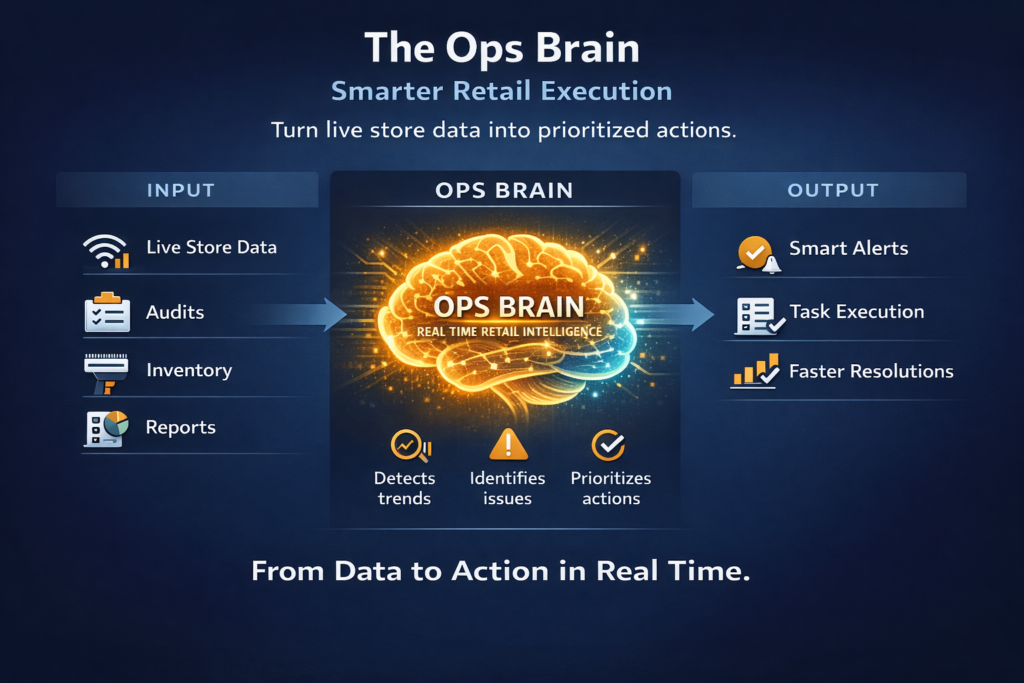
Instead of waiting for periodic reports, an Ops Brain continuously senses execution across stores. It connects audit outcomes, SOP adherence, task flows, inventory signals, and exception reports into a single operational view. Intelligence is no longer fragmented or delayed.
This approach aligns with how modern retail teams use platforms like Proceso. Not as another reporting layer, but as an operational intelligence layer that sits inside execution itself. It helps teams detect issues early, prioritise what matters, and act with clarity across large store networks.
Why Checklists Are Reaching Their Limits
Checklists have played a crucial role in standardising retail operations. However, they were designed for control, not cognition.
Checklists confirm that tasks were completed. Dashboards summarise trends and performance. Neither can correlate patterns across locations, identify priority issues in real time, or suggest what action should happen next.
As retail operations become more dynamic, intelligence must evolve beyond static artifacts. It must be able to observe, interpret, and respond. Much like a brain that centralises diverse signals and translates them into meaningful direction for action.
The Gap Between Intelligence and Execution
As store counts increase and formats diversify, the gap between knowledge and action widens. Traditional methods are inherently retrospective. They rely on periodic review cycles and manual interpretation.
In the modern retail environment, this might lead to delay and compound risk. Small execution gaps remain invisible until they turn into revenue loss, customer dissatisfaction, or brand inconsistency.
In fact, large retailers are acknowledging that execution problems extend beyond compliance. More than 2/3rd of retailers in the USA reported that inventory accuracy challenges erode brand trust and sales.
How an Ops Brain Works in Retail Operations
- 1. Continuous Sensing Execution signals are captured as work happens without adding burden to store teams. This creates a live operational picture instead of periodic snapshots.
- 2. Pattern Recognition By connecting data across stores and time periods, the Ops Brain identifies trends and anomalies that point to deeper issues, not just isolated failures. This ability is what allows retail intelligence to become meaningful for store operations.
- 3. Action Enablement Insights are translated into action through task routing, alerts, and escalations. Issues are resolved faster with clear ownership and accountability, closing the loop between intelligence and execution.
From Intelligence to Operational Confidence
The actual value of an Ops Brain is not just limited to visibility but also confidence. Teams are no longer dependent on gut feel or delayed signals. They work with shared awareness and coordinated response.
Over time, best practices are boosted, exceptions are adopted earlier, and operational uniformity is enhanced without strengthening audits or headcount. Retail environments continue to progress, and the need for intelligence that can assess and act alongside teams will only grow.
An Ops Brain is transforming intelligence into a living capability that drives execution at scale, connecting strategy to outcomes in every store and format.
Final Thought
Retail operations don’t fail because teams lack effort. They fail when intelligence arrives too late to influence decisions.
An Ops Brain ensures that insight, context, and action move together, helping modern retail organizations operate with clarity, consistency, and confidence.