

Jewellery Retail thrives on presentation; a well-lit diamond tray, a balanced necklace arrangement, and a pristine showcase can instantly influence how customers perceive value and craftsmanship.
Every visual element inside the showroom contributes to shaping the consumer journey. As your brands expand across cities, malls, and high street locations, maintaining the same presentation standards across every showroom becomes increasingly complex.
While most retailers establish detailed visual merchandising guidelines, translating those standards into consistent store execution is far more challenging.
For multi-store jewellery brands, retail visual merchandising needs to evolve beyond a basic designing tool to an operational discipline supported by structured processes, visibility, and execution monitoring.
Why Jewellery Retail Demands Operational Precision?
Trust-driven purchase behaviour
High-value buying evaluation
Seasonal Demand and Collection Rotation
Consistent brand experience
Where Jewellery Retailers Lose Control?
- Field teams spend large amounts of time conducting manual audits.
- Photo reporting through informal channels provides limited verification.
- Central teams review updates with delays, slowing corrective action.
- Regional stores interpret guidelines differently.
- Visibility into store-wise execution remains fragmented.
- Mismatch between displayed products and inventory availability
- Planogram interpretation differences
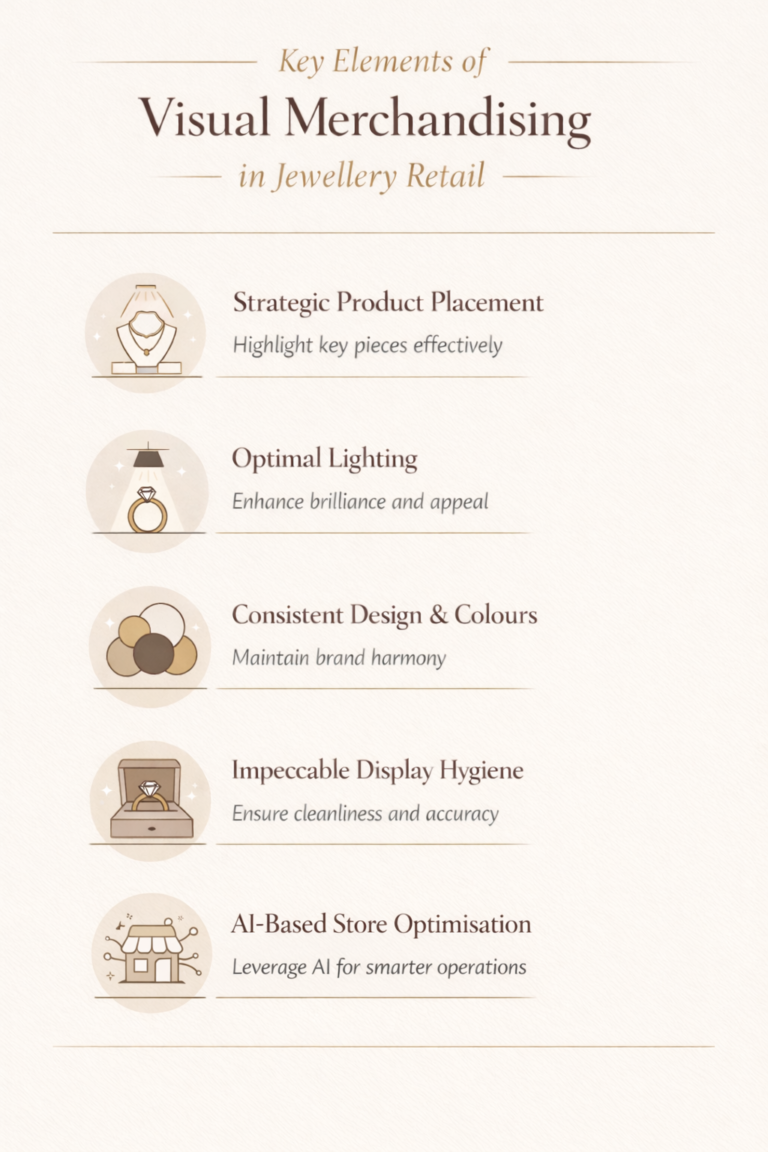
Elements of Retail Visual Merchandising That Drive Store Performance in Jewellery
Showcase Hierarchy and Product Visibility
High-value pieces, such as bridal sets, diamond solitaires, and statement necklaces, should be placed in prime showcase zones and on eye-level trays. Supporting collections creates a natural flow that encourages customers to explore multiple product categories.
Retailers typically define this hierarchy through planograms, which standardise how collections are presented across stores.
Synchronizing Display Inventory with Backend Stock
Ensuring that display inventory reflects current stock availability allows sales associates to seamlessly transition from product presentation to assisted selling.
Tray Level Discipline in Assisted Selling Environments
Maintaining tray level discipline across necklace busts, ring trays, and bangle displays ensures that the presentation remains polished even during busy customer interactions.
For multi-store jewellery brands, this discipline is difficult to maintain without structured store-level monitoring.
Maintaining Display Accuracy
Retailers need to maintain high showroom standards. Automated checklists for every store routine that allow regular validation of display conditions can help them to comply with such high standards.
Because jewellery stores handle high-value products, display hygiene and accuracy are a must as a daily operational process rather than an occasional correction.
How AI is Reshaping VM strategies for Jewellery Retail?
Computer vision for showcase validation
Data Analytics for store-level insights
AI-assisted summaries and reporting
Implement end-to-end retail visual merchandising solution
How Proceso Bridges the Execution Gaps?
- Guided store visit workflows help standardise how VM checks are performed across locations, improving audit consistency.
- Computer vision-based image validation enables objective verification of showcase compliance.
- Automated visit summaries highlight critical deviations quickly, allowing leadership to act faster.
- Real-time visibility across stores ensures that execution gaps are detected early rather than after they impact customer experience.
Conclusion
In a category where purchases are emotional and high value, presentation carries enormous influence.
Customers notice the shine of a diamond, the polish of a gold necklace, and the elegance of a well-arranged showcase. But more importantly, they notice consistency.
For jewellery retailers expanding across India, the competitive advantage will increasingly come from how reliably each store delivers the same premium experience. Because in modern jewellery retail, beautiful displays attract attention.