

Proceso

How Automated Food Safety Audit is Driving 40% Better Hygiene Outcomes in QSRs? 

How Automated Food Safety Audit is Driving 40 Better Hygiene Outcomes inQSRs

Maintaining consistent hygiene standards in QSR (quick service restaurants) is a regulatory requirement, but it directly adds to customer trust, reputation, and operational continuity.  

But traditional approaches to food safety audits are highly manual, lack scalability, and are also prone to errors.  

For modern, rapidly expanding QSRs, automation can redefine the way audits are conducted, traced, and personalized. 

Here, we will discuss the gaps that an automated food safety audit can fill, adding up to 40% better hygiene practices and operational efficiency for QSRs.   

The Importance of Food Safety Audits in Compliance and Quality

FSA is a systematic, well-documented evaluation of whether a QSR or any other food business meets defined safety, quality, and regulatory requirements. Far from being a bureaucratic exercise, these assessments serve a crucial operational function.  

They verify the effectiveness of Hazard Analysis and Critical Control Point (HACCP) plans, confirm that allergen management protocols are being followed, and establish whether suppliers across the chain are meeting the standards your brand has committed to. 

Quick-service restaurants operate at high volume across multiple locations, often with high staff turnover and time-pressured environments. This combination creates an elevated risk of hygiene non-conformances going undetected, which is precisely where automated audit systems deliver their most measurable impact. 

What is Automated Food Safety and Why Does it Matter?

Consistent auditing supports several globally recognised standards that increase trust with major retail partners and end consumers alike. In competitive QSR markets, that trust is a tangible commercial advantage. 

Automated food safety refers to the use of digital technology, including platforms that support AI-driven monitoring tools and auto escalation, to manage, track, and enforce food safety standards without relying on manual, paper-based processes. 

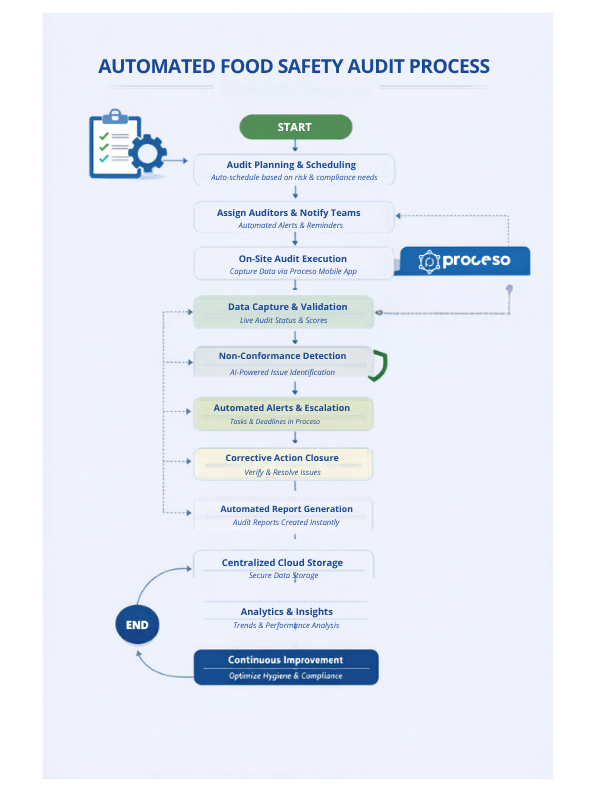
At its core, it replaces clipboards and spreadsheets with systems that work continuously in the background. Temperature deviations are flagged the moment they occur. Hygiene checks are logged in real time. Non-conformances trigger instant alerts rather than sitting in a paper trail waiting to be reviewed. 
Food Safety

Automation changes the operating model entirely, from reactive to proactive, from periodic to continuous. 

The practical impact spans three areas.  

  • First, risk visibility: automated systems surface hazards, whether a temperature breach in cold storage or a missed hygiene check on the floor, before they escalate into incidents.  
  • Second, audit readiness: because data is captured and stored automatically, businesses are always audit-ready rather than scrambling to compile records ahead of a scheduled inspection.  
  • Third, regulatory confidence: with global standards like FSSC 22000 requiring increasingly rigorous documentation, automated audit trails provide the evidence base that manual systems simply cannot produce consistently at scale.  

Key Features to Look for in an FSA Automation Platform

Mobile-first data capture

Audits and hygiene checks completed on-site, including offline functionality for areas with limited connectivity. Data syncs automatically once a connection is restored.

Configurable audit templates

Forms that adapt to specific audit types, whether that is a daily opening checklist, a quarterly supplier assessment, or a BRCGS preparation audit, without requiring technical configuration for each change.

Real-time performance dashboards

Instant visibility of open actions, audit scores, and non-conformance trends across all sites, enabling management to act on data rather than wait for compiled reports.

Automated reporting

Scheduled or on-demand reports are generated without manual data aggregation, removing a significant administrative burden from technical and compliance teams.

Secure, centralised cloud storage

Centralized and secure data management is essential for audit integrity. 

Modern platforms leverage cloud ecosystems such as Microsoft Azure to: 

  • Ensure data security and compliance 
  • Enable real-time synchronization across locations 
  • Support scalability for multi-site operations 

Solutions like Saxon’s Azure-backed compliance platforms combine cloud storage, AI capabilities, and workflow automation, enabling organizations to manage audits seamlessly while maintaining enterprise-grade security.  

Reducing Administrative Burden Through Smart Compliance Management

For many food professionals, the biggest challenge is not maintaining standards. It is proving them during a “food safety audit”. 

Automated FSA facilitated digital compliance management that addresses this gap by bringing the entire process into a unified, intelligent system.  

  • Proceso is an intelligent compliance and audit platform that integrates seamlessly into daily operations, enabling organizations to manage their food safety audit workflows with greater accuracy and control. 
  • Proceso ensures that data is centralized, accessible, and protected, while supporting scalability across multiple locations. Its configurable workflows and real-time dashboards provide clear visibility into compliance status, helping teams always stay audit-ready. 
  • By reducing dependency on manual processes, Proceso minimizes administrative overhead and eliminates inefficiencies associated with fragmented systems. 
  • Proceso can analyse workflow data to identify recurring issues, highlight inefficiencies, and recommend actionable improvements. This allows organizations to move beyond reactive compliance and build a more proactive, data-driven approach to food safety management. 

Advancing Food Safety with AI-Powered Monitoring

The F&B industry has demonstrated consistent adaptability and rapidly evolving consumer expectations around provenance and transparency. Technology adoption in food safety is following the same trajectory: what begins as competitive differentiation quickly becomes an operational necessity. 

The convergence of AI and ML is set to redefine what a food safety audit looks like.  

  • Predictive maintenance tools will flag equipment risks before they generate safety incidents.  
  • Computer Vision and Image Recognition will monitor temperature, humidity, and contamination risk continuously.  
  • AI-powered platforms will identify patterns in audit data that human reviewers would miss, surfacing systemic risks earlier and with greater precision. 

But the foundational quality management processes, HACCP verification, allergen control, and supplier qualification, will not change.   

How Automated Food Safety Audit is Driving 40% Better Hygiene Outcomes in QSRs? 

How Automated Food Safety Audit is Driving 40 Better Hygiene Outcomes inQSRs

Maintaining consistent hygiene standards in QSR (quick service restaurants) is a regulatory requirement, but it directly adds to customer trust, reputation, and operational continuity.  

But traditional approaches to food safety audits are highly manual, lack scalability, and are also prone to errors.  

For modern, rapidly expanding QSRs, automation can redefine the way audits are conducted, traced, and personalized. 

Here, we will discuss the gaps that an automated food safety audit can fill, adding up to 40% better hygiene practices and operational efficiency for QSRs.   

The Importance of Food Safety Audits in Compliance and Quality

FSA is a systematic, well-documented evaluation of whether a QSR or any other food business meets defined safety, quality, and regulatory requirements. Far from being a bureaucratic exercise, these assessments serve a crucial operational function.  

They verify the effectiveness of Hazard Analysis and Critical Control Point (HACCP) plans, confirm that allergen management protocols are being followed, and establish whether suppliers across the chain are meeting the standards your brand has committed to. 

Quick-service restaurants operate at high volume across multiple locations, often with high staff turnover and time-pressured environments. This combination creates an elevated risk of hygiene non-conformances going undetected, which is precisely where automated audit systems deliver their most measurable impact. 

What is Automated Food Safety and Why Does it Matter?

Consistent auditing supports several globally recognised standards that increase trust with major retail partners and end consumers alike. In competitive QSR markets, that trust is a tangible commercial advantage. 

Automated food safety refers to the use of digital technology, including platforms that support AI-driven monitoring tools and auto escalation, to manage, track, and enforce food safety standards without relying on manual, paper-based processes. 

At its core, it replaces clipboards and spreadsheets with systems that work continuously in the background. Temperature deviations are flagged the moment they occur. Hygiene checks are logged in real time. Non-conformances trigger instant alerts rather than sitting in a paper trail waiting to be reviewed. 

Food Safety

Automation changes the operating model entirely, from reactive to proactive, from periodic to continuous. 

The practical impact spans three areas.  

  • First, risk visibility: automated systems surface hazards, whether a temperature breach in cold storage or a missed hygiene check on the floor, before they escalate into incidents.  
  • Second, audit readiness: because data is captured and stored automatically, businesses are always audit-ready rather than scrambling to compile records ahead of a scheduled inspection.  
  • Third, regulatory confidence: with global standards like FSSC 22000 requiring increasingly rigorous documentation, automated audit trails provide the evidence base that manual systems simply cannot produce consistently at scale.  

Key Features to Look for in an FSA Automation Platform

Mobile-first data capture

Audits and hygiene checks completed on-site, including offline functionality for areas with limited connectivity. Data syncs automatically once a connection is restored.

Configurable audit templates

Forms that adapt to specific audit types, whether that is a daily opening checklist, a quarterly supplier assessment, or a BRCGS preparation audit, without requiring technical configuration for each change.

Real-time performance dashboards

Instant visibility of open actions, audit scores, and non-conformance trends across all sites, enabling management to act on data rather than wait for compiled reports.

Automated reporting

Scheduled or on-demand reports are generated without manual data aggregation, removing a significant administrative burden from technical and compliance teams.

Secure, centralised cloud storage

Centralized and secure data management is essential for audit integrity. 

Modern platforms leverage cloud ecosystems such as Microsoft Azure to: 

  • Ensure data security and compliance 
  • Enable real-time synchronization across locations 
  • Support scalability for multi-site operations 

Solutions like Saxon’s Azure-backed compliance platforms combine cloud storage, AI capabilities, and workflow automation, enabling organizations to manage audits seamlessly while maintaining enterprise-grade security.  

Reducing Administrative Burden Through Smart Compliance Management

For many food professionals, the biggest challenge is not maintaining standards. It is proving them during a “food safety audit”. 

Automated FSA facilitated digital compliance management that addresses this gap by bringing the entire process into a unified, intelligent system.  

  • Proceso is an intelligent compliance and audit platform that integrates seamlessly into daily operations, enabling organizations to manage their food safety audit workflows with greater accuracy and control. 
  • Proceso ensures that data is centralized, accessible, and protected, while supporting scalability across multiple locations. Its configurable workflows and real-time dashboards provide clear visibility into compliance status, helping teams always stay audit-ready. 
  • By reducing dependency on manual processes, Proceso minimizes administrative overhead and eliminates inefficiencies associated with fragmented systems. 
  • Proceso can analyse workflow data to identify recurring issues, highlight inefficiencies, and recommend actionable improvements. This allows organizations to move beyond reactive compliance and build a more proactive, data-driven approach to food safety management. 

Advancing Food Safety with AI-Powered Monitoring

The F&B industry has demonstrated consistent adaptability and rapidly evolving consumer expectations around provenance and transparency. Technology adoption in food safety is following the same trajectory: what begins as competitive differentiation quickly becomes an operational necessity. 

The convergence of AI and ML is set to redefine what a food safety audit looks like.  

  • Predictive maintenance tools will flag equipment risks before they generate safety incidents.  
  • Computer Vision and Image Recognition will monitor temperature, humidity, and contamination risk continuously.  
  • AI-powered platforms will identify patterns in audit data that human reviewers would miss, surfacing systemic risks earlier and with greater precision. 

But the foundational quality management processes, HACCP verification, allergen control, and supplier qualification, will not change.   

Share the Post: