

Introduction
Fast-moving consumer goods (FMCG) are products for daily consumption in large quantities. These products have extremely short shelf lives. Managing products with extremely short shelf lives is a high-stakes balancing act between keeping your shelves stocked and reducing waste.
If a consumer is looking for fresh fruits and is unable to find they often leave the store. On the other hand, overstocking to ensure a “full look” can cause huge financial loss due to spoilage.
To maintain the balance, leveraging technology is the only way because it helps you understand the patterns of ever-changing consumer behaviour.
Intelligent automation platforms can help you streamline your daily activities, such as inventory, on-shelf availability, planograms, and daily reports. This helps modern retailers ensure consumers can find what they are looking for while keeping spoilage as low as possible.
The Challenge of Minimising Spoilage in the FMCG Industry
Minimising spoilage is one of the complicated issues faced by FMCG while handling short shelf-life products.
- Products sold through both offline and online mediums require a robust return and exchange policy to give a high-class consumer experience. In case a consumer receives or buys spoiled products, return policies must be implemented.
- Storage of spoiled products for a longer period not only leads to spoilage but also increases the chances of supplying those products to consumers.
- When products reach the retail stores, they must have a certain shelf life. If not, the retailer is forced to give discounts and sales-outs for those products to sell them quickly.
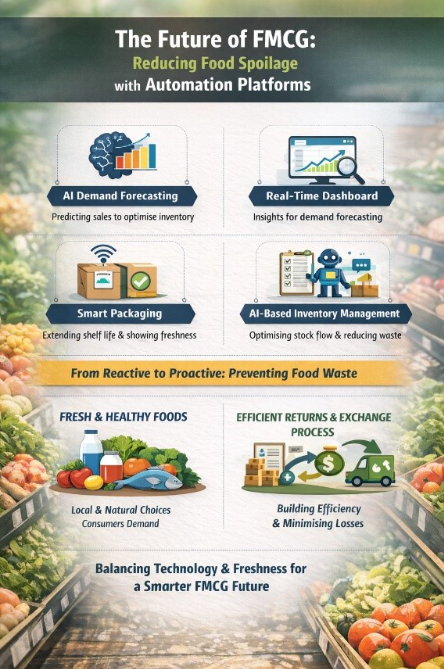
- There is an increasing demand for fresh, local, natural, and healthy products in terms of dairy products, fruits, vegetables, meat, fish, and so on. Freshness is associated with health, and consumers believe that packed and preserved foods are not healthy.
Best Practices to Manage Short Shelf-Life Products
Real-time dashboards and analytics
Analysing each product will guide you on how much you need to buy. If the product sells-to-spoil ratio is high based on the analytics, it’s optimal to stock less to avoid losses
Inventory Management System
It is easier to manage the shelf life when dealing with a huge number of product categories.
Keeping products at “Eye-Level”
Designing and regularly updating planograms where you keep the products near to expire at the eye level of consumers. Products at eye-level are 82% more likely to be picked and purchased.
Product availability can be optimised based on the shelf-placement of products that are required to be sold faster.
Regular inspections
How Proceso can help to Optimise Product Availability in FMCG?
Planogram Compliance
Inventory Management
Spoilage Control Through Checklists
Automated Alerts and Approvals
Real-Time Dashboards for Demand Forecasting and Planning
Efficient Returns and Exchange Process
Proceso facilitates efficient returns/exchange for FMCG products. This brings all internal stakeholders into a single communication channel for faster decision-making. This results in efficient returns/exchange processes for products, avoiding losses for retailers and enhancing relationships between retailers, distributors, and manufacturers.
The Road Ahead
Moreover, the changing consumer demand for fresh, natural, and healthy foods has changed the way FMCG retailers operate. The need to meet this demand has prompted brands to adopt systems that help them maintain speed and localisation without compromising on the ‘freshness factor’.